
Safely through the dark doldrums with long-term heat accumulators
What do heat accumulators have to do with dark doldrums?
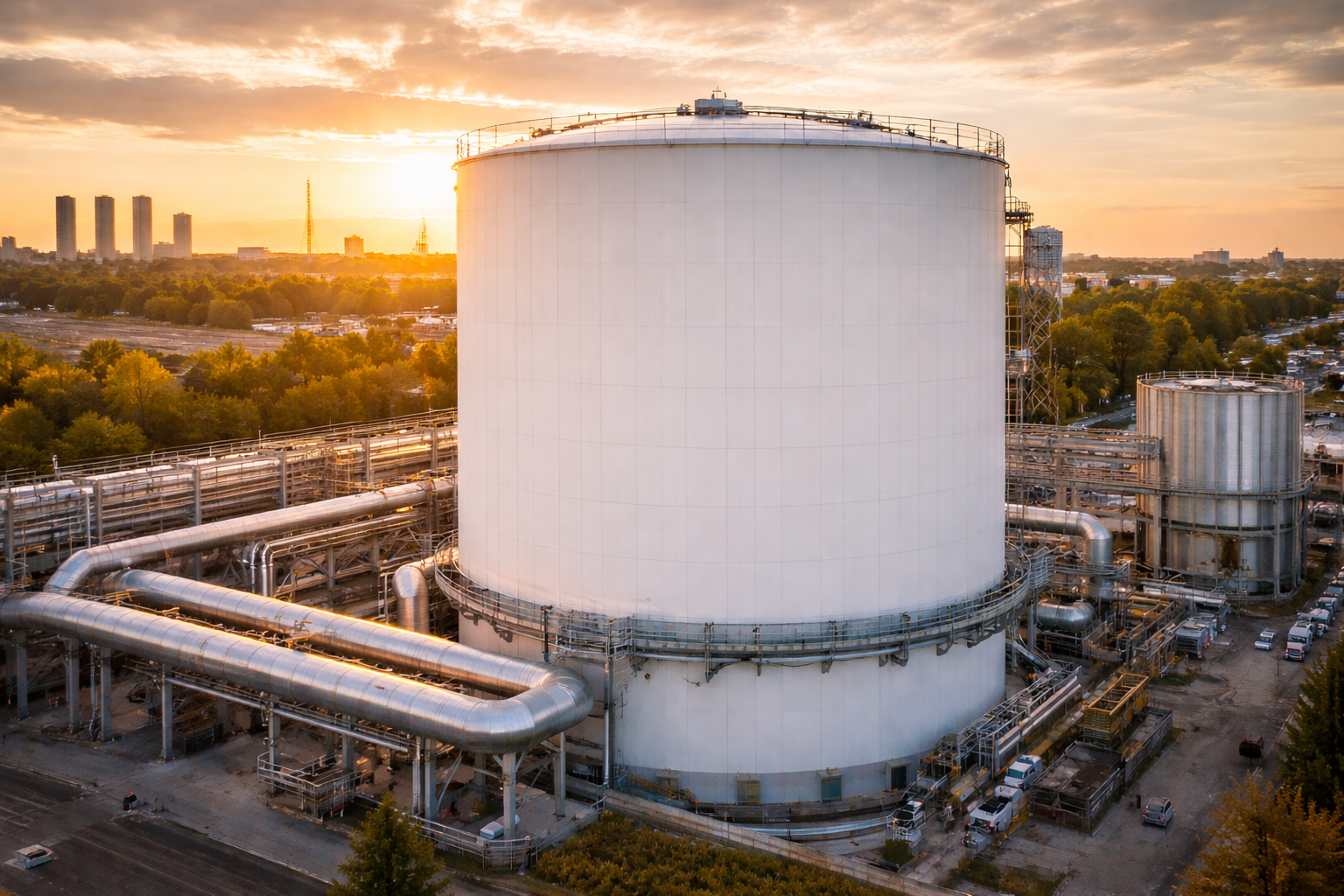
True, they store heat and not electricity. But that's exactly the point: to control electricity consumption. If less electricity is consumed, less has to be generated. With the increasing Electrification heat is becoming an increasingly important part of electricity and heat storage systems indirectly help to relieve the electricity system during periods of darkness. We currently produce a large proportion of the heat we need by burning natural gas. If we Heat in storage tanks If we are able to store heat, we gain power for a secure supply during the dark doldrums. In addition, heat storage systems can Efficiency of district heating systems and serve as a heat source for large heat pumps, for example. It is worth taking a look at Denmark.
How does (long-term) heat storage help through the dark doldrums?
When heat storage systems reduce electricity consumption during a dark doldrums, they help to get through this critical phase for the electricity system safely. For example, if the storage system stores process heat that would otherwise be generated using electricity, the demand load is reduced (example: Power block). With Flash pasteurisers This reduces the residual load peaks, which is already valuable during a dark doldrums. Long-term heat storage on the other hand, can reduce electricity consumption over the entire dark doldrums. In our neighbouring country Denmark already has some long-term heat storage facilities, that buffer heating networks, for example. In this way, they make an active contribution to security of supply.
Save natural gas in winter with heat
A lot of heating is required, especially in winter. Round Room heating accounts for 70 per cent of the annual energy consumption of an average German household. So it is precisely when we use a lot of heat that the risk of dark doldrums is highest. Natural gas is still the most important energy source for heat generation. Long-term storage means that wind and solar power can also be used in winter, especially in the winter months. Replace natural gas and reduce our dependence on imports. Long-term heat storage systems therefore contribute to Security of supply with.
„A large geothermal storage facility with a capacity of 70,000 m³ was built in Høje Taastrup near Copenhagen in 2022. It is connected to the district heating network and is intended in particular to optimise the use of CHP plants in the electricity market. It should pay for itself after 12 years, with heat prices of 0.7 to 1.8 cent/kWh and 10 or 25 cycles. Long-term heat storage systems like these are already economical today and contribute to security of supply.“

Heat accumulators: technology & types of accumulators
Long-term heat accumulators are not an art in principle. They absorb excess heat by using a material with high heat storage capacity (such as water, rock or special phase change materials). Effective insulation prevents the heat from being lost over long periods of time so that it can be released again when required to compensate for fluctuations in the energy supply.
The following is an overview of Different types of long-term heat accumulators as well as examples of companies that develop or offer them. Each type of storage system has its own advantages and areas of application, from high-temperature storage systems to underground solutions. The list is certainly not exhaustive. However, it illustrates that the solutions for tomorrow are already available today.
Underground tank Long-term storage
One example of an existing underground long-term storage tank is called „eTank“. This is a long-term heat storage tank for the home in which heat from a solar thermal system is stored underground with the help of a heat pump. The eTank extends to a depth of around 1.5 metres into the ground. Polyethylene pipes are embedded in the ground. The surrounding soil is heated by these pipes filled with brine: the solar heat flows directly into the underground storage tank, which can also absorb low-temperature heat sources such as exhaust air heat. In this way, heat produced in summer can be transported into winter with only minimal losses.
One example of a provider is deematrix
Underground heat storage tank
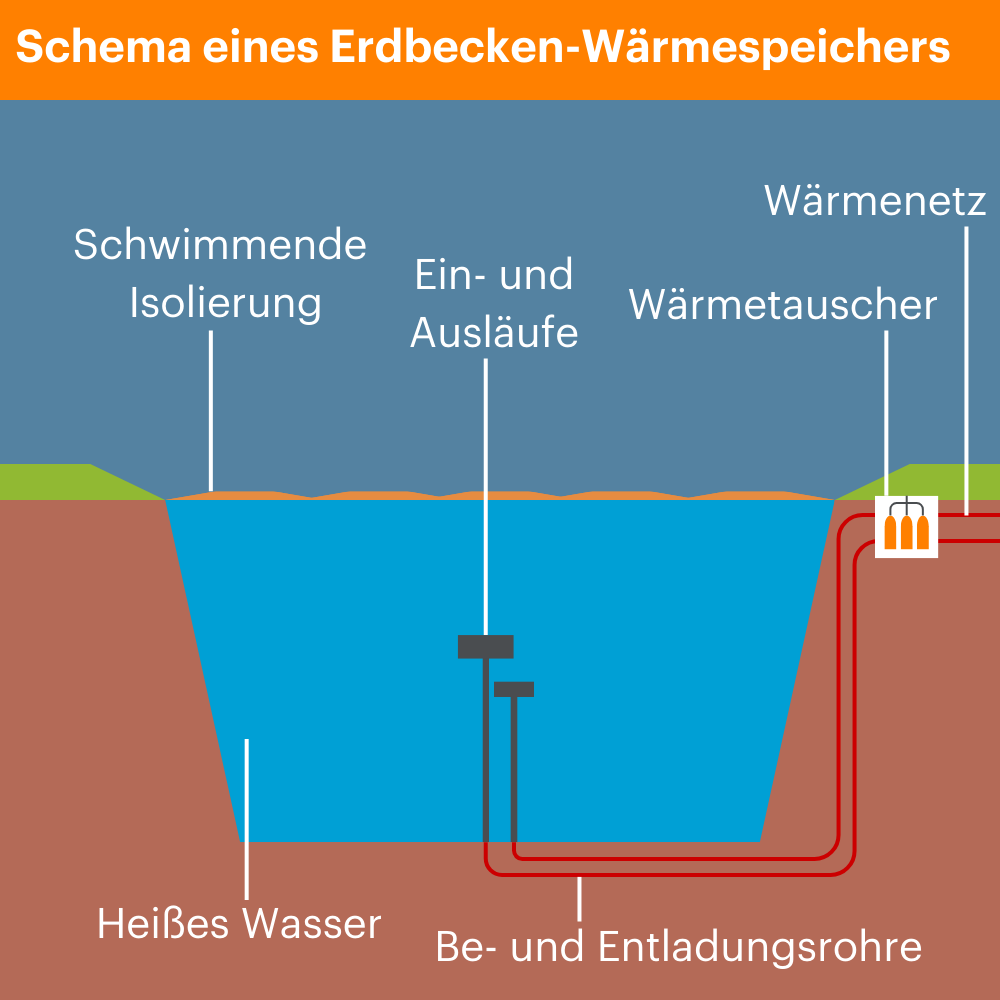
An underground thermal store is a large, artificial basin in the ground that is filled with water, insulated and covered. It stores excess heat from the summer, for example from solar thermal systems or waste heat, so that it can be utilised again in the winter. The water in the storage tank can be heated up to 95 °C and thus serves as a seasonal energy store. A floating cover ensures that as little heat as possible is lost and protects the storage tank from rain and dirt. In the Efficient Pit project, researchers are developing new materials and construction methods to make this cover and the geomembranes more efficient, durable and cost-effective. Underground heat storage tanks are considered a cost-effective and multifunctional solution, as they can combine heat from different sources and provide it over long periods of time.
Long-term geothermal storage / solid-water system
The storage tank consists of a solid material, usually cement, which is placed under the building as a thermal backfill material. The pores of this material are filled with water, which greatly increases the heat storage capacity. Water pipes are integrated into the storage tank as heat exchangers, which are connected to the building's heating system. The water circulating in the pipe system absorbs heat from the cement (in winter) or releases cold (in summer). For example, solar heat from the summer can be stored and used later for heating or hot water. These storage tanks are designed to minimise the impact on the environment and to be durable and highly efficient.
One example of a supplier is SCHEER Heizsysteme
Molten Salt heat accumulator
A molten salt heat storage system, also known as a molten salt storage system, utilises molten salts that can absorb and store heat at high temperatures and release it again when required. The technology works by using concentrated solar energy to heat a salt mixture. The molten salt serves as a storage medium and later releases its stored heat to generate steam or direct heat supply. This system is used, for example, in one of the world's largest solar parks in Dubai and in industrial processes where heat needs to be decoupled between generation and consumption. The advantages include high thermal conductivity and the ability to store large amounts of energy at constant temperatures. Molten salt heat storage systems are primarily used in the form of large-scale systems.
One example of a provider is Siemens Energy
Concrete thermal store
A concrete thermal store utilises the volume of a solid concrete component or specially cast concrete modules as a heat storage medium: heat exchangers embedded in pipes conduct heating or cooling fluid through the concrete, which heats or cools it and stores the energy in its mass. Thanks to its high mass and density, concrete achieves a high heat capacity and is suitable for applications such as building core activation (walls/ceilings as heating/cooling surfaces) or industrial long-term storage at temperatures of many 100 °C. Typical fields of application include the building sector for utilising solar or environmental heat as well as industrial processes with waste heat or process heat sources.
One example of a provider is EnergyNest
Steel storage tanks, glass slag storage tanks, or similar concepts
A steel storage system stores heat by converting surplus wind and solar power into heat via an electric heater using „power-to-heat“. This heat is used to heat a storage core made of steel plates, steel balls or glass slag balls to between 300 and 1300 °C. Due to the high energy density of the storage material, a large amount of heat can be stored in a small area and heat can be released when required. Thanks to the robustness of the material, such storage tanks are durable. Steel storage tanks therefore offer a technically mature solution for making volatile renewable energy flexibly usable - an important component for a stable supply despite dark doldrums.
One example of a provider is Power block
Safely through the dark doldrums: the two-page guide
The fact paper "Dark doldrums" shows on two pages how dark doldrums can be overcome today, tomorrow and the day after tomorrow. Which fuels will we use? Which technologies will be used? How will battery storage help? How will biogas develop over the next few years? We have summarised the most important points on this website for you.