
Long-term storage for wind and solar power
With long-term storage through the dark doldrums
As the name suggests, long-term storage units store energy over particularly long periods of time. The stored energy can be in the form of electricity, heat, chemical energy or in other ways. The storage period varies greatly depending on the technology and ranges from from days to years.
Long-term storage solves the issue of dark doldrums finally on. If these technologies are cheap and available on a large scale, solar and wind energy will also be available during dark doldrums. They also make it possible to bridge long dark doldrums with 100 per cent renewable electricity possible. The more long-term storage systems we have in our electricity system, the less we are dependent on Turbines and motors dependent on the Fuels electricity. In the long term, long-term storage is therefore absolutely essential in order to build a secure, resilient and climate-neutral electricity system.
Securing the power supply even during long periods of darkness
Seasonal shift in favourable energy over weeks and months
Are fully charged for longer periods and therefore offer increased resilience potential
Additional compensation for price fluctuations
Reduction of curtailment losses
Replacement of „reserve power plants“
When will there be long-term storage?
Gaseous long-term storage facilities for renewable energies already exist. These include, for example, biomethane, which is stored in gas storage facilities or green hydrogen. Hydrogen engines or turbines already exist. Small H2 turbines are already available today and larger turbines are under development. However, the available quantities of biomethane are manageable and the earliest we can expect reasonably relevant quantities of green hydrogen is probably In the mid two thousand and thirties to be reckoned with.
Although some technologies are already available on the market, long-term storage systems are not yet widely used. The costs per stored kilowatt hour are still too high compared to a newly generated kilowatt hour of electricity. The Lack of economic attractiveness so.
Examples of long-term storage
Numerous companies are working on innovative solutions, which play a decisive role in the safety and Decarbonisation of our energy system. Here you will find an overview of the range of long-term storage facilities available in January 2026. The list is secure not complete. We have named the best-known manufacturers for each technology.
Liquid air reservoir
A liquid air storage system uses electricity to compress air and simultaneously cool it down to around -190 °C until it is liquefied. The liquid air is stored in isolation and reheated and vaporised as required, with the enormous increase in volume during the transition from liquid to gas driving a turbine, which in turn generates electricity. To increase efficiency, the heat generated during compression and the cold released during vaporisation are stored and reused later in the process.
One example of a provider is Highview Power.
Compressed air reservoir
A compressed air storage system compresses air in large containers or underground caverns. When required, the air is expanded, usually additionally heated and channelled through turbines that generate electricity again. One of the largest compressed air storage facilities is located in Germany (Speicher Huntdorf). However, this is currently being converted to store hydrogen. There are now much more modern compressed air storage systems worldwide. As with liquid air storage systems, modern systems utilise heat storage in order to use the heat generated during compression to increase efficiency at a later date.
Iron-air batteries
Iron-air batteries store energy by oxidising iron metal in the presence of oxygen from the air (discharging) and releasing electrical energy in the process. When charging, this process is reversed: the iron oxide is reduced back to metallic iron using electricity, while oxygen is released. As iron is cheap and plentiful, such batteries are considered to be potentially inexpensive long-term storage devices. They work more slowly than lithium-ion batteries, but are suitable for large amounts of energy and long storage times.
One example of a provider is Form Energy.
Vanadium flow batteries
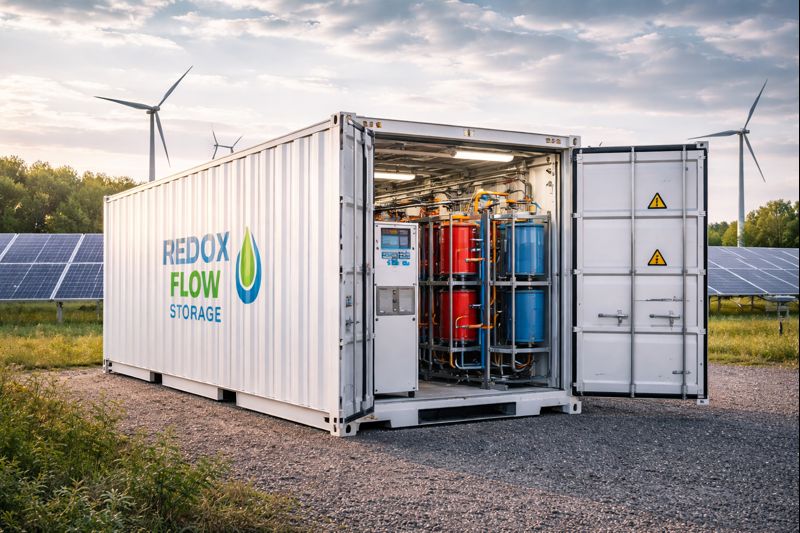
Vanadium flow batteries are redox flow batteries that utilise a vanadium-based electrolyte liquid. During charging and discharging, the liquids are pumped through an electrochemical cell, where dissolved vanadium ions change their oxidation state and thereby accept or release electrons. The amount of energy depends on the size of the tank and the power depends on the size of the cell. This makes redox flow batteries very flexible. The more tanks are integrated into the system, the greater the storage capacity. It would even be possible to transport the energy stored in the electrolyte liquid in the tanks to other locations. In addition, vanadium flow batteries are very durable. Although the cost of the vanadium electrolyte is high, it can be completely reused. They can also undergo any number of cycles without losing capacity (cycle stability).
Providers are for example Dalian Rongke Power and VSUN Energy
Zinc-iron flow batteries
Zinc-iron flow batteries are redox flow batteries that work in a similar way to vanadium flow batteries. However, compared to vanadium, zinc and iron are cheaper and more environmentally sustainable to procure. Weview is the only company we know of that uses this technology. It is to be used for the first time in a project in China in 2035.
One example of a provider is Weview Energy
Organic Flow Batteries
CMBlu offers organic flow batteries on the German market. This redox flow battery does not use metal ions that change their oxidation state. Instead, an electrolyte based on organic compounds is used. This is particularly sustainable and potentially much more cost-effective, as vanadium, for example, can be dispensed with. So far, the long-term stability of the electrolyte liquid has posed a challenge.
One example of a provider is CMBlu Energy
CO2 battery
A CO2 battery stores electricity by liquefying CO₂ gas under compression and using it to store energy. When required, the liquid CO₂ is vaporised again using stored heat, driving a turbine and generating electricity - the entire process takes place in a closed cycle without releasing CO₂.
One example of a provider is EnergyDome
Advanced lithium and sodium batteries
Lithium batteries are now the standard for short-term battery storage. Sodium batteries are currently making massive inroads into the market. For example, in the latest generation of Chinese electric cars. Significant further developments could lead to long-term potential here.
Second-life batteries
Second-life batteries are mostly former vehicle batteries, but in future will also include cells from today's large batteries that will be repowered after a few years. They are available at very favourable prices, and although their remaining number of cycles is reduced, as long-term batteries they also run relatively few cycles per year, which is why this does not matter.
Heat stone storage
A heat-stone storage system (also known as a high-temperature or stone storage system) stores energy by using surplus electricity to heat large masses of stone, concrete or sand to several hundred degrees Celsius. The heat block is very well insulated and retains the heat for months. The stored thermal energy can later be dissipated via air or special heat transfer media and converted back into steam, for example, to generate electricity. Thermal storage units are also available for industrial applications.
Providers are for example Rondo Energy or Power block
Safely through the dark doldrums: the two-page guide
The fact paper "Dark doldrums" shows on two pages how dark doldrums can be overcome today, tomorrow and the day after tomorrow. Which fuels will we use? Which technologies will be used? How will battery storage help? How will biogas develop over the next few years? We have summarised the most important points on this website for you.